
July 29, 2026 | Project C.U.R.E
The first minutes after birth are the most critical in a child's life. Nearly half of all deaths in children under five happen within the first 28 days, and birth complications, including birth asphyxia, are among the leading causes. In Ghana, newborn survival remains a serious challenge: roughly 18 neonatal deaths occur for every 1,000 live births, and birth asphyxia alone accounts for 28–30% of them.
These high neonatal deaths prompted Project C.U.R.E. to go to Obuasi, Ghana last February. To help ensure more healthcare workers are ready to act in what's known as the golden minute," the first 60 seconds after birth, when quick, correct action can be the difference between life and death.
From February 23–27, 2026, Project C.U.R.E. Master Trainers Jeanine Punt and Jennifer Fisher led an Essential Newborn Care (ENC 1) training for 24 healthcare professionals from 14 facilities, brought together by AngloGold Ashanti Obuasi Mine. ENC 1 focuses on care in the first 60 minutes of life, which is the most vulnerable window for both mother and baby.
Over two intensive days, participants worked through World Health Organization-recommended, time-bound interventions:
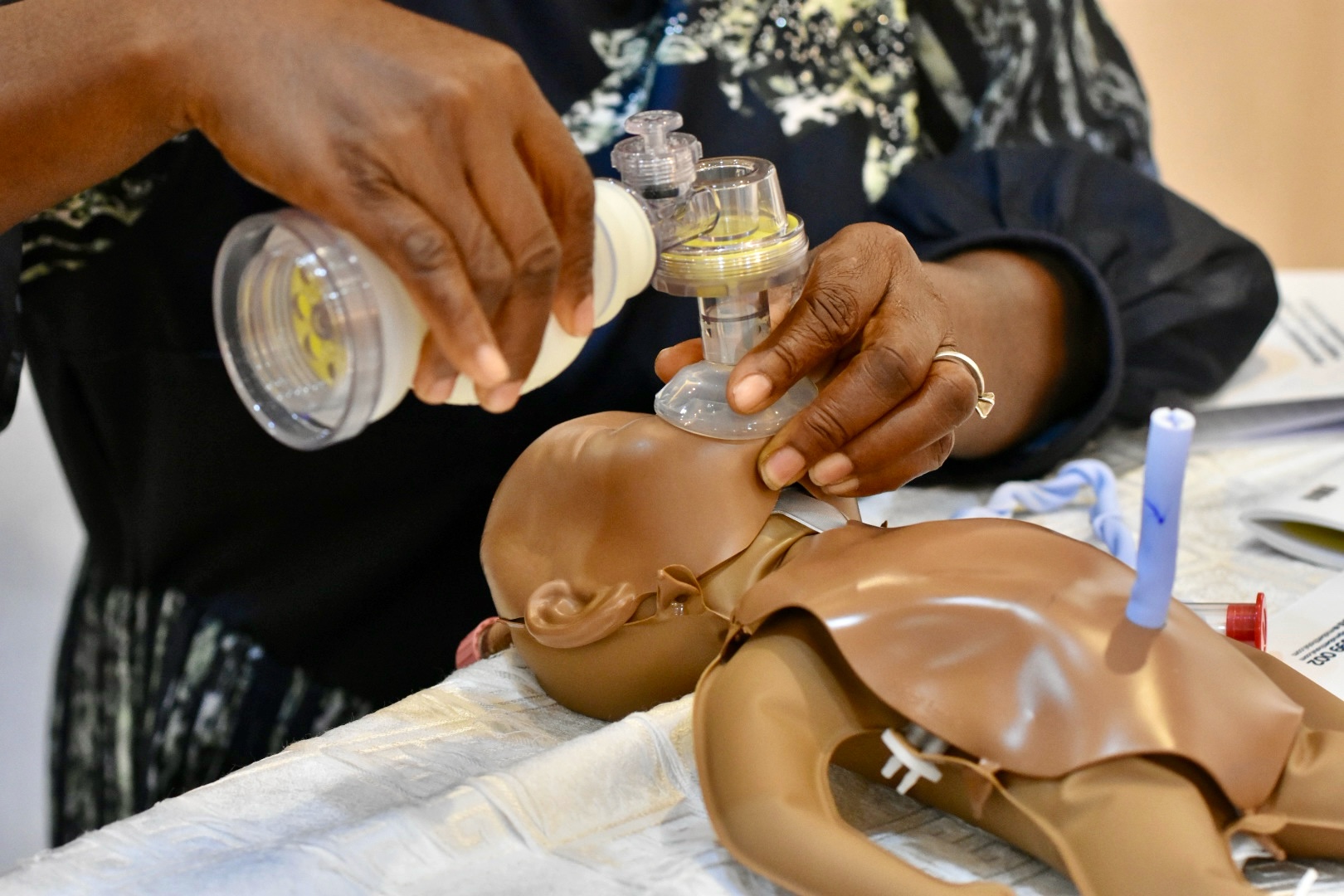
They also practiced newborn resuscitation on simulation mannequins, preparing for the moments that matter most. As one midwife put it:
"One minute really passes very rapidly, so we must be prepared always for a ventilation scenario."
The training sparked real shifts in how participants think about newborn care. A few reflections from the group:
"A baby with no heartbeat and no spontaneous breathing after 20 minutes can be considered a dead baby. So there is no need to transfer the baby to [the neonatal intensive care unit] NICU." - Vida, midwife and head of NICU, AngloGold Ashanti Health Foundation Hospital
"I learned that suction is hardly needed. It takes too much time as well." - Abigail, midwife
"I learned that there is no need for CPR actually. Breathing or ventilating is far more important, without a good flow of oxygen in the body CPR will not work anyway." - Dominic, ER Nurse
One of the most powerful outcomes came from one of the participants. Midwife Ester Ekuban developed a practical monitoring chart to support 15-minute newborn checks. She shared it with the class, and the group discussed how to put it to use across their facilities.
"I am really making an impact with this training… I have identified gaps in our practice and am finding new ways to save these wonderful babies and their mums." - Ester Ekuban, midwife
Through Project C.U.R.E.'s Train-the-Trainer model, four new master trainers were certified in Obuasi, with additional future trainers identified along the way. That means this training won't stop with the 24 professionals in the room — its impact will keep multiplying across Ghana.
This ENC training is one piece of a broader, multi-year partnership between Project C.U.R.E. and AngloGold Ashanti, advancing healthcare delivery in Ghana through:
By investing in both people and systems, this partnership is building sustainable change and helping ensure that more babies not only survive birth but thrive beyond it.

